



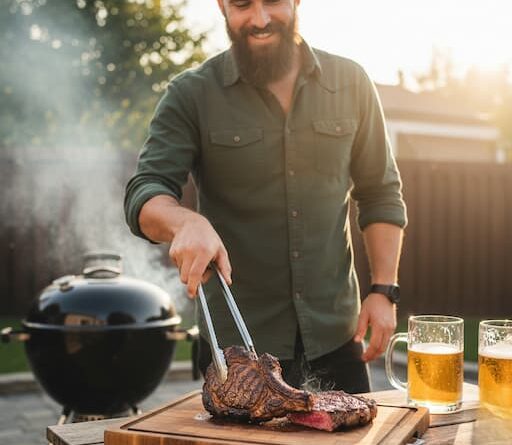
Alright guys, let’s cut through the noise. You’re standing in front of a gorgeous hunk of beef, your grill is fired up, and you’re about to perform what should be a simple, sacred ritual. But then the doubt creeps in. Is it hot enough? When do I flip it? Is it going to turn into a leathery hockey puck destined for the dog, a tragedy of biblical proportions? Fear not. We’re about to turn you from a backyard beginner into a steak slinging sensei. Forget the fancy French terms and the foodie nonsense. This is straight talk for men who want to eat like kings.
The Foundation: Picking Your Player
Before you even think about lighting that fire, you need the right piece of meat. This isn’t rocket science, but it is meat science, and it’s glorious. Walk into any decent grocery store and you’ll see a wall of options. Let’s break it down.
First, the cut. For grilling, you want something with good marbling, that’s the white flecks of fat inside the muscle. That fat equals flavor and juiciness. A New York Strip is your reliable best friend. It’s got flavor, it’s got a little fat cap, and it’s hard to mess up. A Ribeye is the decadent uncle. More fat, more marbling, more glorious beefy flavor. It’s a party in your mouth. Filet Mignon is the lean, tender option. It’s like dating a supermodel, impressive to look at but sometimes lacking the personality of a Ribeye. And then you have the T-Bone or Porterhouse, which is basically a two-for-one special featuring both the Strip and the Filet. A bold choice for a hungry man.
The Thickness Matters
Do not, I repeat, do not bring home a sad, thin, half inch steak. You will overcook it. I guarantee it. You want a steak that’s at least an inch to an inch and a half thick. This gives you a beautiful sear on the outside and a perfectly cooked interior. It gives you control. A thick steak forgives a few extra seconds on the grill. A thin one does not.
The Pre-Game: Salt, Pepper, and Patience
You’ve got your steak. Now, the seasoning debate. You’ll have guys tell you you need a rub with 17 different spices, including ground-up meteorite dust. They are wrong. For a truly great steak, you need two things: coarse kosher salt and freshly cracked black pepper. That’s it. The beef is the star. You’re just the hype man.
Now, when to season? This is where the “experts” get into fistfights. Some say right before. Some say hours before. Here’s the no-BS take. Take your steak out of the fridge at least 30 to 45 minutes before it hits the grill. You want it to come closer to room temperature. A cold steak will cook unevenly. While it’s sitting there on the counter, looking all beautiful, give it a generous coating of salt and pepper on all sides. The salt will pull a little moisture to the surface, which will then dissolve the salt and help it penetrate the meat. This is a good thing. Let it sit. Have a beer. This is the mandatory patience portion of our program.
Fire It Up: Mastering the Heat
Charcoal or gas? Look, I’m a charcoal guy. It gives a flavor you just can’t get from a gas flame. It’s more primal. But if all you have is a gas grill, you can still make a phenomenal steak. Don’t let anyone tell you otherwise. The key is creating two zones: a hot zone and a cool zone. On a charcoal grill, you pile the hot coals on one side. On a gas grill, you turn one burner on high and leave the other off. This is your secret weapon for managing the cook and avoiding a charcoal-coated hockey puck.
Your grill needs to be screaming hot. I’m talking “sear a steak in 60 seconds” hot. If you can’t hold your hand three inches above the grates for more than two seconds, you’re in the zone. This intense heat is what creates the Maillard reaction. That’s just a fancy term for the delicious, brown, crusty goodness you get on the outside. It’s the difference between a steamed steak and a grilled one.
The Main Event: The Cook
Here we go. Toss that seasoned beauty right over the hot side of the grill. You should hear an immediate, aggressive sizzle. If you don’t, your grill isn’t hot enough. Now, leave it alone. Don’t poke it. Don’t press it down with your spatula. You’re not making a panini. You’re releasing precious juices. Let it cook for a good 2-4 minutes, depending on thickness, until it develops a nice crust and releases easily from the grates. If it sticks, it’s not ready to flip. Then, flip it once. Just once. We’re not making flapjacks.
After you get a good sear on the second side, this is where the two-zone fire earns its keep. If your steak is getting too dark but isn’t up to temperature yet, move it to the cool side of the grill. Close the lid. This lets the heat circulate and cook the inside gently without torching the outside. This is how you get that perfect pink center from edge to edge.
The Finger Test: Ditch the Thermostat (Mostly)
I know, I know. Instant read thermometers are accurate. But constantly stabbing your steak lets the juices run out. Learn the finger test. It makes you look like a pro. Relax your hand and touch the fleshy part of your palm right below your thumb. That’s what a raw steak feels like. Now, touch your thumb to your index finger and feel that same part of your palm. That’s what rare feels like. Thumb to middle finger is medium rare. Thumb to ring finger is medium. Thumb to pinky is well done, but for the love of all that is holy, please don’t cook a beautiful steak to well done. If you’re nervous, use a thermometer to confirm. 125°F for rare, 135°F for medium rare, 145°F for medium. Always pull the steak off the grill about 5 degrees before it hits your target temp, as it will continue to cook while resting.
The Final, Non-Negotiable Step: The Rest
You did it. You navigated the heat, you mastered the flip, you passed the test of patience. What you have now isn’t just dinner. It’s a masterpiece. It’s a perfectly grilled steak, cooked with confidence and common sense. So crack open a cold one, fellas. You’ve earned it. Now, who’s hungry?
You’ve cooked the perfect steak. You’re hungry. You want to slice into it right now. Do not do it. This is the ultimate test of willpower. You must let it rest. Transfer your steak to a cutting board and just leave it alone for at least five to ten minutes, about half the total cooking time. All those juices inside are going crazy from the heat. If you cut it open immediately, they’ll all flood out onto the board, leaving you with a dry steak. Letting it rest allows the muscle fibers to relax and reabsorb those juices. When you finally slice it, every bite will be moist and flavorful. Trust me on this. It’s the difference between good and legendary.
Slicing and Serving Like a Boss
Resting time is over. The moment of truth. Always slice your steak against the grain. Look at the meat, you’ll see lines running in one direction. That’s the grain. You want to cut perpendicular to those lines. This shortens the muscle fibers, making the steak much more tender and easy to chew. For a Strip or a Ribeye, this usually means slicing it into nice, half-inch strips. Pile them up on a platter. Maybe drizzle just a little of the juices that collected on the cutting board over the top. That is liquid gold.
You did it. You navigated the heat, you mastered the flip, you passed the test of patience. What you have now isn’t just dinner. It’s a masterpiece. It’s a perfectly grilled steak, cooked with confidence and common sense. So crack open a cold one, fellas. You’ve earned it. Now, who’s hungry?