



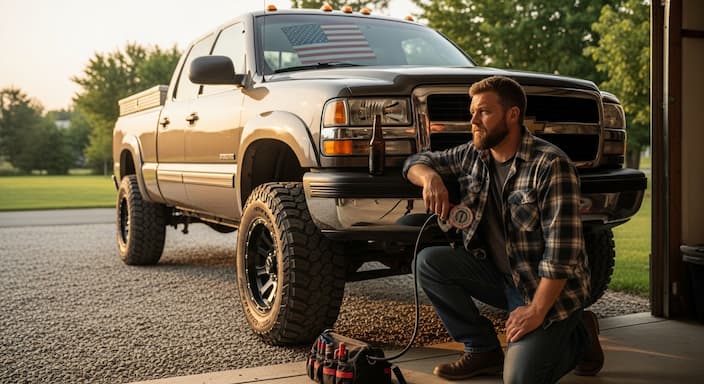
Let’s be honest for a second. Most guys treat their tires like they treat their lawnmower…ignore it until something goes wrong, then act surprised when it costs a stack of cash to fix. I get it. Tires aren’t sexy. They’re round, black, and spend their lives getting kicked, curbed, and covered in road salt. But here’s the truth you’re not gonna hear from the guy trying to upsell you on a ceramic coating: your tires are the only thing between your truck, your family, and a very bad day.
Whether you’re rolling a lifted F-250, a classic C10, or a Harley bagger, those four (or two) patches of rubber are doing the heavy lifting. They’re stopping you from sliding into the ditch, keeping your ride stable when you’re hauling a trailer, and frankly, saving your bacon when some distracted driver decides to merge into your lane without looking. So, before you drop another dime on a cold air intake or a set of LED light bars, let’s talk about keeping your rubber right. Because tire care isn’t just maintenance…it’s common sense.
The Air Pressure Myth (And Why Your Dashboard Is Lying to You)
Pop quiz. When’s the last time you actually checked your tire pressure with a gauge? If you’re like most of us, you rely on that little yellow light on the dash to tell you when something’s wrong. Big mistake. Those TPMS sensors are great for alerting you when you’re about to roll on a flat, but they’re notoriously lazy. They usually don’t trigger until you’re already 20-25% below the recommended PSI. By then, you’re already chewing through tread, killing your gas mileage, and making your truck handle like a shopping cart with a wobbly wheel.
Here’s the rule: check your pressure cold, once a month. And I mean cold, not after you’ve been bombing down the highway for an hour. Heat builds pressure, giving you a false reading. Look at the door jamb sticker on your driver’s side, not the max pressure printed on the tire sidewall. That number on the tire is the limit, not the recommendation. Run your tires where the manufacturer says, and you’ll notice the difference immediately. Better ride, better grip, and you won’t be buying new rubber every 30,000 miles because the centers are worn bald.
Tread Depth: The Penny Test Isn’t Just for Grandpas
We’ve all heard the penny trick. Stick Abe Lincoln headfirst into the tread, and if you can see the top of his head, it’s time for new tires. That’s the baseline. But if you’re running a truck that actually works for a living…towing, hauling, or spending weekends on gravel roads…you want to be a lot more aggressive than that.
I swap my all-terrains when they hit 4/32 of an inch, not the legal minimum of 2/32. Why? Because traction in rain and snow drops off a cliff once you dip below that magic number. I don’t know about you, but I’ve got better things to do than white-knuckle it through a spring downpour because I wanted to squeeze another 5,000 miles out of a set of tires. Consider it an insurance policy. Fresh tread means you stop faster, corner flatter, and don’t end up being the guy blocking traffic because you slid through an intersection.
Alignment and Rotation: The One-Two Punch
You know that feeling when you’re driving down a straight road and your steering wheel looks like you’re trying to merge into the next lane, but the truck is going straight? That’s an alignment issue. And if you ignore it, you’re going to start seeing weird wear patterns…feathering on the edges, cupping, all that fun stuff that makes your tires roar like a worn-out wheel bearing.
Alignments aren’t just for when you hit a curb or replace suspension parts. They’re a regular thing. Every 10,000 miles or so, especially if you drive on rough roads or do a lot of towing. Pair that with a proper rotation every 5,000 to 7,000 miles, and you’ll double the life of your tires. Rotations keep the wear even because your front tires take a beating every time you turn the wheel. It’s cheap, it’s easy, and skipping it is just lazy.
The Visual Inspection You’re Probably Skipping
I’ll admit it. I’ve been guilty of walking past my truck a hundred times without giving the tires a second look. But that one time you do look, you might spot a nail you picked up three weeks ago, or a bubble in the sidewall that’s ready to blow. Sidewall damage is a silent killer. If you see a bulge or a cut that’s deep enough to show cord, that tire is done. Don’t patch it. Don’t try to get another season out of it. Replace it.
And while you’re down there, check your valve stems. Those little rubber guys dry out and crack, especially if you live somewhere with real winters. A cracked valve stem is a slow leak that’ll drive you crazy trying to find. Replace them when you get new tires, or sooner if you notice air pressure dropping for no good reason.
Seasonal Swaps: Snow Tires Aren’t a Scam
I know the debate. Some guys swear by all-terrains year-round, and that’s fine if you’re in the South or you don’t see real winter. But if you live where the snow flies and the temperature drops below freezing for months, a dedicated set of winter tires changes the game. It’s not about being able to plow through a snowbank. It’s about stopping on ice. The rubber compound in winter tires stays flexible in the cold, and the siping gives you grip that no all-season can match.
Think of it this way. You wouldn’t wear flip-flops to a job site. So why run summer-focused rubber when the roads turn into a skating rink? A second set of wheels with snow tires pays for itself the first time you avoid a fender bender. Plus, it extends the life of your summer or all-terrain set because you’re splitting the mileage between two sets. It’s a win-win.
The Money Talk: Don’t Be a Cheapskate
Look, I get it. Tires are expensive. When you’re looking at a set of five for your 4×4, it stings. But here’s where guys get it backwards. They’ll drop five grand on a lift kit, another grand on wheels, and then buy the cheapest tires they can find on the internet. That’s like putting bargain-bin sneakers on an Olympic sprinter.
Your tires are the part of your vehicle that actually touches the road. They dictate how well you brake, how you handle in a corner, and how much noise you have to listen to on a road trip. You don’t need to buy the most expensive mud-terrain on the market, but buy something reputable. Read reviews from guys who actually use their trucks. Ask around at the local shop. A solid set of tires from a trusted brand is worth every penny when you’re cruising through a mountain pass with a camper hooked up behind you.
Wrap-Up: Rubber Side Down, Always
At the end of the day, taking care of your tires is about respect. Respect for your ride, respect for the people riding with you, and respect for everyone else on the road. It’s not flashy. Nobody’s gonna gather around at a cars and coffee to admire your properly inflated tires and spotless rotation history. But you know what? You’ll be the guy who gets home safe every time. You’ll be the one who doesn’t have to explain to the wife why you need a tow truck in the middle of a rainstorm.
So next time you’re standing at the pump filling up, take two minutes. Check the pressure. Walk around and look at the tread. Give your sidewalls a glance. It’s cheap, it’s easy, and it’s the smartest thing you can do to keep your truck on the road and out of the shop. Good rubber isn’t an expense. It’s an investment in getting where you’re going without any drama. And that, fellas, is money well spent.