



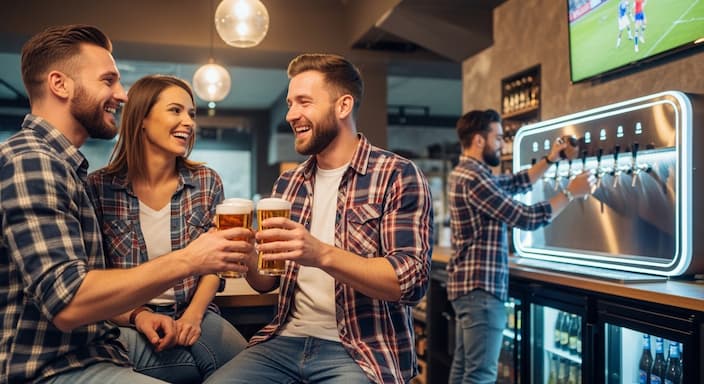
Pull Up a Stool, the Robot’s Buying This Round: How Tech is Remaking Your Local
There’s a certain rhythm to a good night out. You walk into your local, the lighting’s low, the jukebox is playing something with a guitar riff you actually like, and the guy behind the bar gives you a nod. He knows your order. A frosty mug slides across the bar, foam head intact, and for the next few hours, the world outside those doors can take a number. It’s a ritual as old as time, or at least as old as the invention of the refrigerated keg.
But fellas, we’re staring down the barrel of a change. The old-school hangout is getting a silicon injection. From Seoul to Manchester, and even in the secret labs of Big Beer, technology is muscling in on our territory. The question is, is this gonna ruin the vibe, or are we about to enter a golden age of never missing a minute of the game because some rookie can’t work the tap? Grab a cold one, and let’s sort this out.
The 24/7 Joint: When the Bartender is a Terminal
Imagine this: It’s 4 AM. The Champions League final just kicked off. You’re amped, your buddies are amped, but every bar within a twenty-mile radius has been closed for hours. In Seoul, they’re not imagining it. They’re living it. Heineken just rolled out something called “Trust Bars” in the Hongdae district [citation:1].
We’re not talking about a vending machine with warm cans. This is a fully automated, 24/7 bar. You walk in, you order at a terminal, and you pour your own fresh, perfect pint of lager. The system handles payment, tracks the pour, and even uses cameras and AI to make sure the drunk guy who’s had one too many can’t get another. It’s unstaffed, untended, and always open [citation:1].
My first reaction was pure skepticism. A bar without a bartender? That’s like a BBQ without the smoke. The bartender is the gatekeeper, the therapist, the guy who cuts you off before you do something stupid, and the fella who slides a free one your way when you’ve had a rough week. But the more I think about it, the more I see the twisted logic, especially for the sports fanatic.
This isn’t meant to replace your Friday night hangout. It’s for the 4 AM game. It’s for the Monday afternoon holiday when everyone else is working. It’s solving a real problem. High labor costs mean bars can’t stay open for the niche hours. This tech fills the gap. It’s a little dystopian, sure, but so is watching your team score a banger from your living room couch when you could be high-fiving strangers.
Frictionless Drinking: The Arena Upgrade
Now, let’s take this concept and drop it into a place we all know and love to hate: the big arena. You’re at a concert or a playoff game. You’ve got ten minutes before the headliner comes on or the third period starts. You make a break for the concession stand. You know the drill. You stand in a line that snakes halfway to the parking lot. You watch the clock tick. You finally get to the front, yell your order over the din, and miss the opening face-off. It’s a tragedy.
Over in the UK, at the Co-op Live arena in Manchester, they’ve decided to do something about it. They just launched a fully autonomous market called “Tap, Grab, Go” [citation:5][citation:8]. We’re talking AI-powered cameras and sensors that track what you pick up. You tap your card to enter, grab a self-pour pint of Guinness or an IPA from a wall of automated taps, and walk out. No checkout, no line, no missing the action [citation:5].
This is where I get on board. This isn’t replacing the soul of the local dive; it’s fixing the soul-crushing inefficiency of the modern mega-venue. The technology, powered by companies like AiFi and Boxbar Tech, is smart enough to know you poured a pint and charge you for it [citation:5][citation:8]. It recognizes pours, man. That’s some serious sci-fi stuff that actually makes your life better. You get back to your seat faster, beer in hand, wallet still intact. That’s a win.
The Secret Sauce: Yeast Gets a PhD
But the tech revolution isn’t just happening in the bar. It’s happening in the back, in the brewery itself. And the biggest breakthrough is happening on a microscopic level. We’re talking about the yeast.
For thousands of years, yeast has had one job: eat sugar, poop out alcohol and CO2. It’s a hell of a good gig. But now, the scientists are messing with the formula. Why? Because you, me, and that 25-year-old kid who does yoga on his lunch break are all drinking less. Beer consumption is down, and the industry is scrambling [citation:4]. Their big hope? Nailing the non-alcoholic beer.
Let’s be honest, NA beer has historically tasted like dishwater that once knew a beer. But companies like AB InBev are pouring millions into their secretive labs in Belgium to fix that. They’ve got a “yeast whisperer” named Kevin Verstrepen and a team of mad scientists who have engineered something called “smart yeast” [citation:4]. This isn’t about brewing a full-strength beer and then cooking the alcohol out, which ruins the flavor. This is about designing a yeast that, by its very nature, produces minimal to no alcohol while still kicking out all those complex, delicious flavor compounds that make a beer taste like a beer [citation:4].
And it’s not just the big guys. Academic research is blowing up on this topic. We’re seeing a huge push into what they call “non-conventional yeasts” [citation:2][citation:9]. These aren’t your dad’s ale or lager strains. These are wild yeasts, plucked from forests, fermentations, and God knows where else, that can create brand new flavor profiles. We’re talking about beers with crazy complex aromas, functional beers with added health benefits, and yes, those tasty low-ABV options that let you have a few without needing a nap [citation:2][citation:9].
Even the way we monitor this magic is getting a tech upgrade. Scientists have figured out they can predict exactly what’s happening inside a fermenter by sniffing the gas it gives off. They analyze the volatile organic compounds (VOCs) in the fermentation gas to track sugar consumption and alcohol production in real-time without ever opening the tank [citation:7]. It’s like a breathalyzer for your beer while it’s still growing up.
The Smart Brewery: Where Robots Make the Beer
And finally, let’s take a look at the factories where the magic is brewed on a massive scale. It’s not just hipsters stirring cauldrons anymore. Head over to the百威 (Budweiser) factory in Putian, China. This place is the future [citation:3].
They’ve got a “1+1+9” smart system running on 5G. A robot dog—yes, an actual robot dog—patrols the floor, checking pipes for leaks and valves for heat using laser radar and thermal cameras. It does in 40 minutes what used to take a man two hours [citation:3]. The packaging line flies at 45 cans a second. Electronic eyes scan every single bottle for the tiniest flaw. This isn’t a brewery; it’s a NASA facility that happens to make something you want to drink [citation:3].
This level of automation means one thing: consistency. Your Bud Light in Tokyo is going to taste exactly like the one in Tulsa. For the big macro brands, that’s the holy grail. And for all of us, it means the beer we grab at the stadium or the corner store is perfect every single time. It might lack the “artisan” romance, but dammit, it’s reliable.
The Last Call Verdict
So, is the soul of the old bar getting squeezed out by circuits and code? Nah. Not really. The tech isn’t coming for the soul; it’s coming for the sucky parts.
The robot bartender isn’t going to replace the guy who knows your name. It’s going to be there for you at 4 AM when the game is on. The AI arena taps aren’t there to rob you of conversation; they’re there to get you back in your seat for the third period. The “smart yeast” isn’t making your favorite IPA disappear; it’s giving your buddy who’s doing Dry January a beer that doesn’t taste like punishment.
The technology is just a tool. A damn impressive one, sure. It’s making better beer, more consistently. It’s keeping places open longer. It’s getting you a cold one faster. But at the end of the day, it’s still about the pour, the foam, the first sip, and the guys you’re sharing it with. The tech just makes sure the beer is cold, the glass is full, and you don’t miss the big play. That’s progress we can all drink to.


