


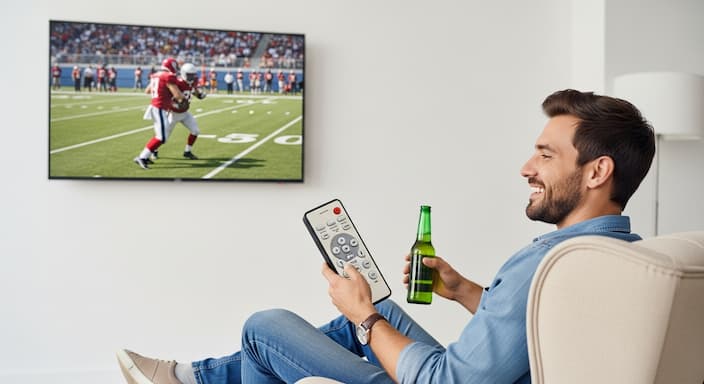
Let me paint you a picture. You’re trying to watch the game. Your buddy’s new remote has 57 buttons, half of them backlit. You need a degree from MIT just to turn up the volume. Your phone is buzzing with notifications from three different smart home apps because the living room lamp is “offline.” Your new coffee maker demands a firmware update before it’ll brew. Suddenly, the simple pleasure of a cold beer and some football feels like you’re manning mission control. What the hell happened? When did our tools stop serving us and start bossing us around?
It’s time for a rebellion. A quiet, simple one. I’m talking about choosing tech that works, right now, without a manual, a subscription, or a panic attack. This ain’t about being a Luddite. I love a cool gadget as much as the next guy. But I love my sanity more. The real innovation isn’t adding more features, it’s stripping away the nonsense until you’re left with something that just… does its job. Perfectly. Let’s talk about why simple tech isn’t just for grandpas. It’s for anyone who values their time, their money, and their peace of mind.
The Tyranny of Too Many Features (And Why You’re Paying For Them)
Walk into any electronics store. Every box screams about what it can do. “4K HDR 240Hz Quantum Dot Smart TV with Voice Assist, Built-in Streaming, and a Fridge.” Okay, I made the fridge part up. But you get the point. Companies are locked in a specs arms race, and guess who’s the battlefield? Your living room. And your wallet.
Here’s the dirty little secret. You are absolutely paying for every single one of those features, whether you’ll ever use them or not. That voice assistant that listens in? You paid for that mic. The eight different streaming services pre-installed? You paid for that extra memory and processing power. That “smart” functionality that requires an app and a monthly account? You funded that development team.
Now, ask yourself. When you watch the game, do you care if your TV has a 0.005 millisecond faster response time? Or do you just care that the picture looks great, the sound is solid, and it turns on when you hit the power button? We’ve been sold a bill of goods that says “more” equals “better.” But more often, “more” just equals “more complicated,” “more expensive,” and “more likely to break in a way you can’t fix.”
The Unbeatable Joy of the Single-Purpose Tool
Think about the greatest tools in your life. Your favorite bottle opener. A reliable hammer. A charcoal chimney starter for your grill. What do they have in common? They have one job, and they do it flawlessly. No buttons. No updates. No chance of them trying to sell you something.
Simple tech follows the same rule. It’s the Kindle Paperwhite. It’s for reading books. It looks like paper, it lasts for weeks on a charge, and it doesn’t have a web browser to distract you. It’s a dumb TV. You plug in a Roku or Apple TV stick and boom, you’ve got all the smart features you need, on a device that costs $40 and updates independently. When the streaming stick gets slow in three years, you replace the stick, not the whole damn television.
It’s a dedicated MP3 player for the garage, loaded with your workout or project playlist, so you’re not getting texts and emails blasting over your speakers. These things are heroes. They resist the urge to be a Swiss Army knife, and because of that, they’re the sharpest, most reliable blade in the drawer.
Your Privacy Isn’t a Subscription Bonus
This is where we get a little more serious, but stay with me. A lot of “smart” tech is free, or cheap, for a reason. You’re not the customer. You’re the product. That voice-controlled speaker needs to listen for its “wake word.” How do you think it gets better at understanding you? It learns. From you. That data is incredibly valuable.
Simple tech often means private tech. A standalone GPS unit for your truck doesn’t track your driving habits to sell to insurance companies. A basic digital meat thermometer with a single probe doesn’t need an app that collects data on your grilling frequency. A stereo receiver from a few years ago just plays music, it doesn’t profile your musical tastes to serve you ads later.
Choosing simpler devices is a quiet vote for keeping your business your own. It says you’d rather pay a few more bucks up front for a tool than pay with your personal information forever. In a world that’s constantly trying to peek over your shoulder, simple tech builds a taller fence.
Durability and the Myth of Planned Obsolescence
Complex tech has more points of failure. More circuits, more code, more moving parts. It’s just math. Simple things last. My dad has a calculator on his workbench from the 1980s. It has the original batteries in it. It still works.
Now think about your smartphone. The software updates get bigger and slower until they finally stop, pushing you to buy a new model. That’s not an accident. That’s a business model.
Simple tech sidesteps this garbage. An FM radio will work after an EMP. A mechanical watch will tick for generations. A well-made, basic tool doesn’t become obsolete because a company shut down its app servers. It just keeps working. Investing in simple, well-built tech is a middle finger to the idea that everything you own should be disposable. It’s choosing the cast iron skillet over the non-stick pan that peels in a year.
Where to Start Your Simple Tech Revolution
Okay, so you’re fed up. Where do you begin? You don’t have to throw your smartphone off a cliff. Start small. Look for the friction points in your day.
In the Living Room
Next time you need a TV, consider a “dumb” display. Just a beautiful screen with a few HDMI ports. Then, control your streaming with a single, simple device like a Roku Express. One remote. One interface. When it’s game time, you hit one button. No hunting through menus.
In the Kitchen & Garage
Seek out appliances with physical dials and buttons. A toaster with a slider and a button. A coffee maker with a simple on/off switch and a clock you can actually set. For the garage, a digital tire inflator with a big, clear screen and a hose is a million times better than fumbling with a confusing app on your phone.
For Your Ears
Wired headphones. Just hear me out. They never need charging. The sound quality is almost always better for the price. And you’ll never lose one in the couch cushions. It’s a beautifully simple solution to the “my earbuds are dead” panic.
The goal isn’t to live in a cave. It’s to be the master of your domain. Every piece of tech in your home should feel like a loyal dog, not a needy cat. It should be there when you call it, do what you ask, and then lay quietly at your feet until you need it again.
So next time you’re looking at some new gadget that promises to revolutionize your life, ask the hard question. “Or, will it just complicate it?” Choose the tool that gets out of the way and lets you get back to the good stuff. The beer, the BBQ, the company. That’s what simple tech really buys you. More of your own life.